

There are rules you follow so automatically that they no longer sound like rules. They sound like truth.
Good women do not disappoint people.
Moms put themselves last.
Rest has to be earned.
Do not ask for too much.
If you want it done right, do it yourself.
You may never have consciously agreed to any of them. Still, they can shape how you work, mother, earn, rest, ask for help, and decide what success is allowed to look like.
That is the problem with inherited rules: they become an operating system before you realize you are running one.
In episode 4 of She Claims Herself, I shared where one of my deepest rules came from, the belief that I had to be the woman who could always figure everything out. It made me capable, resourceful, and determined. It also made receiving support feel far more complicated than it needed to be.
This is not about blaming the past. It is about seeing clearly enough to choose what happens next.
What Are Inherited Rules?
Inherited rules are beliefs, expectations, and survival decisions that you absorbed from family, culture, religion, work, or past experiences without consciously deciding that they belonged in your life.
An inherited rule might tell you who a “good” woman should be, how hard success must feel, how much support you are allowed to receive, or how small you need to stay to keep other people comfortable.
Some of these rules once created safety, belonging, approval, or a sense of control. That does not mean they deserve permanent authority.
The question is not only, “Where did this belief come from?”
The more important question is, “Does it still get to make decisions for me?”
Subscribe To She Claims Herself Podcast with Shay Hrobsky:
Spotify | Apple Podcast | Substack
Connect With Me:
Instagram | LinkedIn | Youtube | TikTok | ShayHrobsky.com
How I Learned to Become the Woman Who Always Figured It Out
When I was around 10 years old, my grandmother died. My mother had lost her best friend, and our entire family was hurting. During that season of grief, someone introduced my mother to the Jehovah’s Witnesses.
As an adult, I can understand what my 10-year-old self could not. My mother was looking for hope and certainty in the middle of pain. I do not tell this story because I blame her. I do not.
But our lives changed.
Before then, I had grown up in a big Black family filled with cousins, aunts, uncles, birthdays, holidays, family dinners, sleepovers, and the kind of loudness that feels like home. When my parents went deeper into the religion, we stopped spending time with people outside it. The loss was bigger than Christmas or birthday cupcakes.
I lost the place where I knew I belonged.
Later, after my freshman year of high school, my parents decided to homeschool me. My mother worked during the day. My father worked third shift. In practice, I was largely homeschooling myself.
I had questions about the religion, and I kept asking them. Eventually, I decided that I needed to build a different life. I graduated from high school at 16, moved out at 16, and started college at 17.
That girl was brave. She was stubborn, funny, resourceful, and wildly determined. She learned a rule that helped her survive:
Nobody is coming. I have to figure it out myself.
The rule worked.... until it worked too well.
When Capability Becomes Hyper-Independence
There is nothing wrong with being independent. There is nothing wrong with knowing that you can handle hard things.
The problem begins when independence stops being a choice and becomes the only state in which you feel safe.
For me, it looked like this: give me Wi-Fi, caffeine, and Google, and I would become wildly confident that I could solve anything. I became the woman who handled it. Built it. Carried it. Fixed it.
Our culture often rewards that version of a woman. She is strong and does it all. She NEVER needs help.
But being treated as an equal is not the same as refusing support. Strength is not measured by how much you can carry without letting anyone see your arms shake.
At one point, I could spend 45 minutes trying to move a couch before asking my husband for help. That is no longer independence. That is cardio and unless I am being chased, who needs that much cardio?
Humor aside, this is what I finally understood:
I was so good at carrying everything alone that I forgot I was allowed to put something down.
Hyper-independence can look admirable from the outside because it often produces results. Underneath those results, however, may be a belief that support is unsafe, receiving creates debt, rest is irresponsible, or needing someone means failing.
What Does Hyper-Independence Look Like in Women?
Hyper-independence can appear differently in every life. For high-achieving women, it may be hidden beneath competence, leadership, or a successful business.
You may recognize it if you:
- wait until you are overwhelmed before asking for help;
- trust yourself to do the work but struggle to trust anyone else;
- feel guilty when you rest before everything is finished;
- automatically say, “I’ll do it,” even when you have no capacity;
- feel safer being needed than being supported;
- interpret receiving help as weakness, inconvenience, or loss of control; or
- build business systems around what you can endure rather than how you want to live.
These patterns do not mean something is wrong with you. They may mean an older version of you found a brilliant way to stay safe and she has been running that strategy ever since.
The Invisible Rules Women Carry Into Life and Business
My story is specific to me, but the pattern is not mine alone. The exact words change; the structure is often familiar.
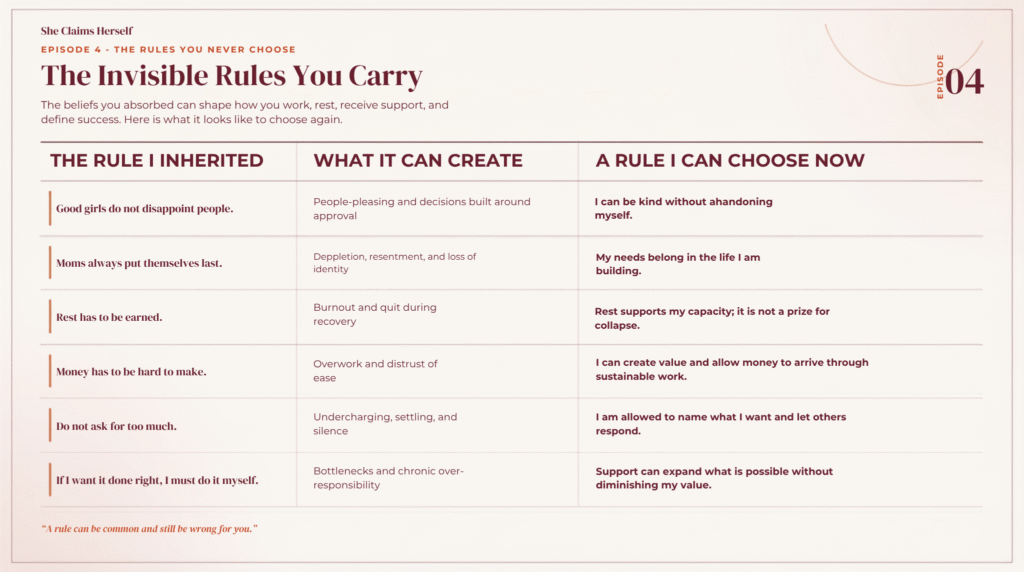
A rule can be common and still be wrong for you. It can come from someone you love and still be yours to release.
How to Identify and Rewrite an Inherited Rule
You do not need to replace your entire identity in one dramatic afternoon. Start with one rule, especially the one that keeps appearing in your calendar, body, relationships, or business.
1. Name the Rule Exactly
Finish this sentence without polishing the answer:
“A good woman, mother, partner, or business owner should…”
Or notice what follows phrases such as “I have to,” “I should,” “I cannot,” and “People like me do not.”
Write the rule in the language you actually hear in your head. Precision matters. You cannot question a belief that remains vague.
2. Ask Who Gave You the Rule
Did it come from your family, faith, community, industry, a former boss, an old relationship, or a season when you had very few options?
This is not an invitation to find someone to blame. It is a way to separate what you learned from what you choose.
3. Understand What the Rule Protected
Maybe the rule helped you avoid criticism. Maybe it kept you connected to people you needed. Maybe doing everything yourself meant no one could disappoint you.
Honor the intelligence in that response. You do not have to shame a survival pattern to outgrow it.
4. Calculate the Current Cost
Ask what this rule costs you now.
Does it cost rest? Intimacy? Money? Creativity? Time with your children? The ability to delegate? The courage to build a business that fits your actual life?
A rule that once protected you may now be collecting rent in every room of your life.
5. Choose a Rule That Fits the Woman You Are Now
A new rule should be believable enough to practice, not so polished that your body immediately rejects it.
For me, the replacement sounds like this:
I am allowed to ask for help. I am allowed to receive. I am safe even when I am supported. I am allowed to build my business differently. I am allowed to rest before I fall apart.
The goal is not to repeat a beautiful sentence once. The goal is to make new decisions until the new rule becomes lived evidence.
You Do Not Have to Reject the Woman Who Survived
For a long time, sharing this story felt like a rejection of my past and of the woman who survived it.
But I love her.
She got me here. I can be grateful for her without letting her make every decision from now on.
That distinction matters. Growth is not a courtroom where you prosecute every former version of yourself. It is an evolution. You can thank the woman who learned to carry everything and still tell her, gently, that she is allowed to put something down.
What got you here does not have to get you to your next level.
You are not becoming a stranger. You are becoming a more consciously authored version of yourself.
What Becomes Possible When You Put the Rule Down?
Maybe you ask for help before you are desperate.
Maybe you stop calling exhaustion ambition.
Maybe your business no longer requires you to disappear inside it.
Maybe you make a decision because it fits your life—not because it satisfies a version of success you inherited from someone else.
The rules that shaped you may explain your past. They do not own your future.
So I want to leave you with two questions:
What rule are you still living by that you never consciously chose?If you set that rule down today, what becomes possible for you?
If something is stirring, start there.
If you want help uncovering the invisible rules shaping your business and choosing what comes next, book an alignment call with me. Together, we can look at what no longer fits and build a business rooted in your capacity, your values, and the woman you are becoming.
Prefer to begin privately? Take the free What’s Off Audit to identify the first part of your business that needs your attention.